Friday, October 9, 2009
October 9,2009
Today in class we did a lab where we had to turn a solid into a liquid. During the process, we had to evaporate the water and record the weight of it before and after.When it was a solid, the substance was red and had a crystal look. While turning it to a liquid, the colour changed from red to blue then light blue.

Thursday, October 8, 2009
OCTOBER 7, 2009
In the beginning of our chemistry class Mr. Doktor taught us how to use a bunsen burner!
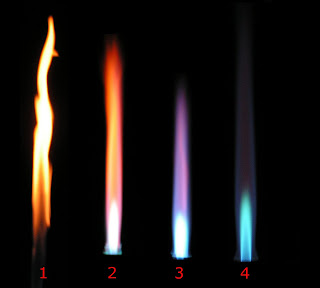 In this picture it shows the different types of flames the bunsen burner can create.
ACIDS
-Solid, liquid, or gas at SATP (standard ambient temp & pressure)
-form conducting aqueous solutions
-dissolve in water to produce H+
-taste sour
BASES
-turn red litmus blue
-slippery
-nonconductive
-dissolve in water to produce OH-
NAMING ACIDS
~acids are aqueous (dissolved in water)
~hydrogen compounds are acids
-HCI(aq)-->Hydrochloric acid
-H(2)SO(4)(aq)-->sulfuric acid
~Hydrogen appears first in the formula unless it is part of a polyatomic group
~CH(3)COOH(aq)-->acetic acid
example HI(aq)--> Hydro Iodic Acid
-classical rules use the suffix IC and/or the prefix HYDRO-
example sulfuric acid
hydrochloric acid
~IUPAC system uses the aqueous hydrogen compound
example HCI(aq)Aqueous hydrogen chloride
NAMING BASES
~for now, all bases will be aqueous solutions of ionic hydroxides
-NaOH
-Ba(OH)2
~use the cation name followed by hydroxide
-sodium hydroxide
-barium hydroxide
these are some examples we went over in class
-H(3)PO(4)(aq) Phosphoric acid
-HNO(3)(aq) Nitric acid
-HNO(aq) Nitrous acid
-Mg(aq) Magnesium hydroxide
-HBr(aq) Hydrobromic acid
-HOOCCOOH(aq) Oxalic acid
We took a break from all the note taking and Mr. Doktor did another experiment :):)
He mixed sulfuric acid with sugar. Here is a video... and you'll see what happens!
ps: instead of the striker, we used the stick and match. Just because we're cool.
HOMEWORK: read pages 252-253
do questions 1-9, 28, 34
 In this picture you'll see the different parts of the bunsen burner (click to enlarge)
 In this picture it shows the different types of flames the bunsen burner can create.
Of course we also did notes about ACIDS AND BASES
ACIDS
-Solid, liquid, or gas at SATP (standard ambient temp & pressure)
-form conducting aqueous solutions
-dissolve in water to produce H+
-taste sour
BASES
-turn red litmus blue
-slippery
-nonconductive
-dissolve in water to produce OH-
NAMING ACIDS
~acids are aqueous (dissolved in water)
~hydrogen compounds are acids
-HCI(aq)-->Hydrochloric acid
-H(2)SO(4)(aq)-->sulfuric acid
~Hydrogen appears first in the formula unless it is part of a polyatomic group
~CH(3)COOH(aq)-->acetic acid
example HI(aq)--> Hydro Iodic Acid
-classical rules use the suffix IC and/or the prefix HYDRO-
example sulfuric acid
hydrochloric acid
~IUPAC system uses the aqueous hydrogen compound
example HCI(aq)Aqueous hydrogen chloride
NAMING BASES
~for now, all bases will be aqueous solutions of ionic hydroxides
-NaOH
-Ba(OH)2
~use the cation name followed by hydroxide
-sodium hydroxide
-barium hydroxide
these are some examples we went over in class
-H(3)PO(4)(aq) Phosphoric acid
-HNO(3)(aq) Nitric acid
-HNO(aq) Nitrous acid
-Mg(aq) Magnesium hydroxide
-HBr(aq) Hydrobromic acid
-HOOCCOOH(aq) Oxalic acid
We took a break from all the note taking and Mr. Doktor did another experiment :):)
He mixed sulfuric acid with sugar. Here is a video... and you'll see what happens!
Just incase you wanted to see how the bunsen burner worked :)
ps: instead of the striker, we used the stick and match. Just because we're cool.
HOMEWORK: read pages 252-253
do questions 1-9, 28, 34
Wednesday, October 7, 2009
October 5, 2oo9
Today in class, we learnt about naming hydrates and their prefixes.
- copper sulfate & sodium sulfate --> without water the compound is often preceded as 'anhydrous'
-these crystals contain water inside them which can be released by heating
TO NAME HYDRATES
- write the name of the chemical formula
- add a prefix indicating the number of water molecules
1-mono
2-di
3-tri
4-tetra
5-penta
6-hexa
7-septa
8-octa
9-nona
10-deca
*KNOW ALL TEN*
Examples:
Name the following compounds:
- Cu(SO4) - 5H2O ---> copper (2) PENTAhydrate
- Li(ClO4) - 3H2O ---> Lithium perchlorate - TRIhydrate
- what is the chemical formula of Nickel(2)sulfate hexahydrate?
Ni(SO4) - 6H2O
MOLECULAR COMPOUNDS
- composted of 2 or more non-metals
- low melting point and boiling point
- share (not exchange) electrons
- usually end in 'gen' (hydroGEN, oxyGEN, nitroGEN)
- 7 molecules are DIATOMIC - 2 of the same elements
-H2, N2, O2, F, Cl2, Br2,I2 - P4, S8 --> Polyatomic
IUPAC NAME/FORMULA
- water - H2O
- hydrogen peroxide - H2O2
- ammonia - NH3
- glucose - C6H12O6
- sucrose - C12H22O11
*KNOW THE FIRST FIVE!!!!!* - methane - CH4
- propane - C3H8
- octane - C8H18
- methanol - CH3OH
- ethanol - C2H5OH
- ethane - C2H6
*Notes were taken down from Mr. Doktors powerpoint, we were given 2 pages of homework, 7-3 Practice Problems & 7-3 Apply worksheets. He's going to be collecting them next class!*
October 1, 2oo9
A. SEPARATING MIXTURES
- there are many methods to separate mixtures, depending on the type of mixture
- by hand-----
--> Heterogeneous Mixture - filtration-----
- distillation:
- crystallization
- chromatography
*All are physical changes

B. REVIEW OF ATOMS
- matter is made up of atoms
- molecules are groups of atoms held together by electrical bonds
- ions are atoms or molecules that have an electric charge
-positive ions are cations
-negative ions are anions - atoms are made up of 3-subatomic particles
- Protons:
-positive charges
-inside nucleus
-each element has a different number of protons
-protons = atomic number - Neutrons:
-neutral
-inside nucleus
-nearly same mass as protons
-adding or removing neutrons does not change the element - Electrons:
-negatively charged
-located outside the nucleus
-1800 times smaller than protons
-chemical reactions occur between electrons in different atoms/compounds
C. PROPERTIES OF THE PERIODIC TABLE
- FAMILIES(or groups) form vertical columns
-all elements of a family have similar traits and characteristics - PERIODS are horizontal rows. Elements gradually chane from metals to non-metals as you move from left to right
D. ELEMENTAL INFORMATION
- exceptions are:
copper - cuprum
gold - aurum
iron - ferrum
lead - plumbum
silver - argentum - first letter is always CAPITAL
- second letter is always LOWER CASE
E. CHEMICAL NOMENCLATURE
- naming chemical compounds has been a very difficult task and different systems have been used through the centuries
- today the most common system in IUPAC for most chemicals
-ions
-binary ionic
-polyatomic ions
-molecular compounds
-acids
F. CHEMICAL FORMULAS
- be aware of the differences between ion and compound formulas
- Zn^2+ (2+ is the ion charge)
-BaCl2 (the 2 is lower)(number of ions)
G. NAMING IONS
- for metals use the name of the element and add ion
-Al^3+ = aluminum ion - for non-metals, remove the original ending and add "-ide"
-F- = Fluorine becomes Fluoride - polyatomic ions have special names
H. BINARY IONIC COMPOUNDS
- ionic compounds contain two elements - one metal and one non-metal
- metallic and non-metallic ions bond together
- election is transferred from the metal to the non-metal
- net charge must be zero - total positive charge - total negative charge
I. NAMING BINARY IONIC COMPOUNDS
- metal name + first part of non-metal "-ide"
J. STEPS
- write formula
- criss-cross charges
- reduce ion numbers to lowest common multiples
September 29, 2oo9
A. CLASSIFICATION OF MATTER

- understanding matter begins with how we name it. We can divide matter into two types: Homogeneous Substances & Heterogeneous Substances
- HOMOGENEOUS: consists of only one visible component
-distilled water, oxygen, graphite - HETEROGENEOUS: contain more than one visible component
-chocolate chip cookie, granite

B. PURE SUBSTANCES
- there are two types of pure substances:
-Elements: substances cannot be broken down into simpler substances by chemical reactions (oxygen, iron, magnesium)
-Compounds: substances that are made up of two or more elements and can be changed into elements (or other compounds) by chemical reactions (water, chocolate chips, sugar)
C. TELLING THE DIFFERENCE
- it is often very difficult to know if something is an element or a compound
-only 'visible' on the atomic level - one method is to connect the substance to an electric current. This technique, called electrolysis, can split the compound apart into its constituent elements
September 24, 2oo9
A. WHAT MATTERS?
- anything that has mass and occupies space
- matter can exist in many different states, the most common are:
-solid, liquid, gas
-plasma, aqueous, amorphous - SOLIDS: holds one shape and has a definite volume
- LIQUID: can change shape, but has a definite volume
- GAS: can change shape and volume
- AQUEOUS: something dissolved in water
- Solid - strong bonds
- Liquid -weak bonds
- Gas - no bonds
- Plasma - ionization
B. CHANGES IN MATTER:
- matter can undergo any changes
- nearly all changes can be broken down into 3 categories:
-physical changes, chemical changes, and nuclear changes
PHYSICL CHANGES:
- involves changing shape or state of matter
-crushing, tearing, ect. - no newsustances are formed
-eg. boiling water, cutting wood, smashing cars
PHASE CHANGES
- changing from a solid to a gas can often be confused as a chemical change
-chemicals remain the same - during the melting process chemicals usually follow this path:

CHEMICAL CHANGE
- new substances are formed
- properties of the matter change
-conductivity, acidity, color, etc.
-eg. iron rusting, burning wood, digesting food
C. CONSERVATION OF MATTER
- in physical and chemical changes, matter is neither createrd nor destroyed...EVER. Period.
- this is called the 'conservation of matter'
September 22, 2oo9
Today in class we had our Chapter 1 Unit Exam!
1. In part one of the exam we had to match the WHMIS symbols with their appropriate labels.
And here they are:

Compressed Gas

Flammable Material


Material Causing Immediate and Serious Toxic Effects

Corrosive Material

Biohazard Infection Material
1. In part one of the exam we had to match the WHMIS symbols with their appropriate labels.
And here they are:

Compressed Gas

Flammable Material

Oxidizing Material

Material Causing Immediate and Serious Toxic Effects

Corrosive Material

Biohazard Infection Material
2. In part two we listed 4 fundamental units of the SI system and their abbreviations.
These units were:
Meter - M
Mole - Mol
Second - S
3. In part three we did fill in the blanks:
When measuring liquid in a chemistry lab first use a graduated cylinder. Most liquids will not form a flat horizontal line but will curve. This curve is called a meniscus. To properly measure the volume of fluid measure to the bottom of the curve. After recording the volume of fluid transfer it to a beaker or test tube.
4. In part four of the exam we had to count how many significant digits were in the following numbers:
1.500m = 4 significant digits
2.0 x 10^-3g = 2 significant digits
0.00202 mL = 3 significant digits
7.01 x 10^4 J = 3 significant digits
Pi = never ending
For the rest of our chapter 1 unit exam we went over unit conversions.
Subscribe to:
Posts (Atom)